Apple Stock Defies AI Selloff Pressure: Lean Capex Becomes Safe Haven
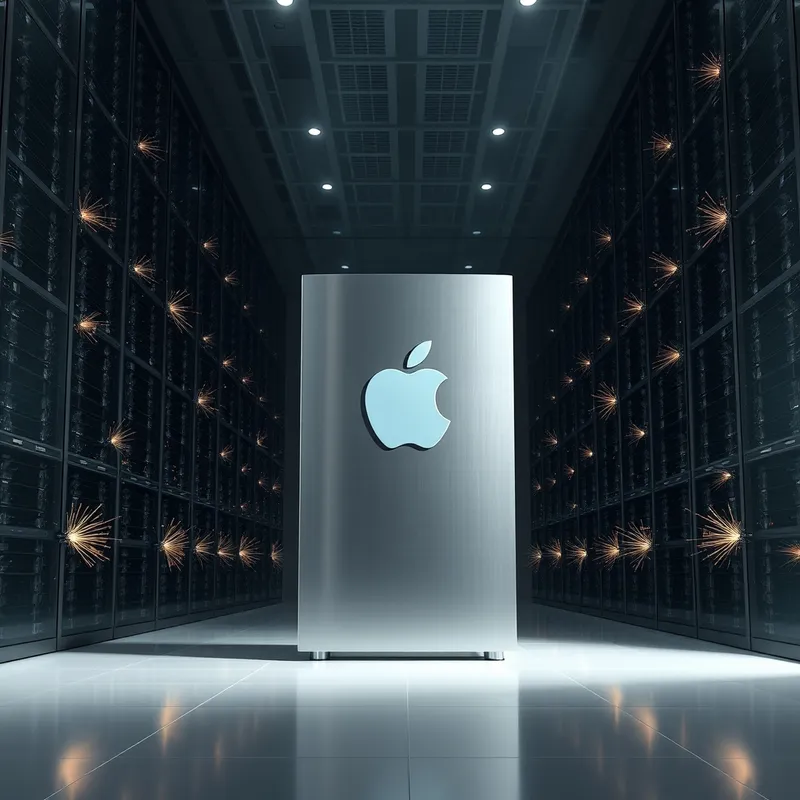
Apple Stock Defies AI Selloff: Is It the Market's Safe Haven?
Market safety is no longer about who builds the future, but who refuses to fund the bill.

Capital preservation has taken a strange shape in the current equity cycle. While mega-cap technology peers hemorrhage capital into heavy data center investments, select entities are benefiting directly from capital restraint. The market is abruptly pivoting away from aggressive infrastructure expansion and rewarding balance sheet discipline.
📊 The Capital Expenditure Divergence and Market Rotation
Global liquidity cycles and shifting risk appetites dictate that when tech indexes pull back from record highs, institutional portfolios undergo a violent defensive rotation. The current equity landscape illustrates this dynamic clearly. Major technology giants have committed staggering sums to artificial intelligence infrastructure, with projected peer capital expenditure surging past hundreds of billions of dollars collectively across firms like Amazon, Microsoft, Alphabet, and Meta.

"[Infrastructure is a bottomless pit until monetization proves otherwise.]"
In stark contrast, Apple scaled back its own capital intensity, reducing direct infrastructure outlays significantly while pivoting its operational strategy toward outsourced model integration. This lean expenditure profile acted as an unexpected financial buffer when the broader tech sector experienced a severe correction. Investors who previously criticized the Cupertino giant for lagging behind in artificial intelligence developments suddenly found themselves holding an entity immune to immediate data center depreciation pressures.
⚙️ Structural Architecture of Outsourced Innovation
The operational mechanics behind this resilience reveal a calculated shift in corporate strategy. Rather than shouldering the immense electrical and hardware costs required to train foundational models from scratch, the hardware ecosystem chose a modular integration path. Heavy computing tasks are offloaded strategically, while consumer-facing upgrades are funneled through external partnerships like Google's Gemini framework.

At the same time, specialized infrastructure is still utilized selectively for intensive cloud tasks through private server deployments powered by industry-standard silicon. This hybrid approach allows the ecosystem to capture the consumer demand upside of new software features without absorbing the crippling capital expenditures plaguing hardware competitors. Outsourcing the capex burden while retaining pricing power is the ultimate margin defense.
Yet, this architectural choice introduces distinct structural dependencies. Relying on external model providers creates a delicate balance between proprietary user experience and third-party partnership risks. Furthermore, rising component costs, particularly memory pricing, threaten to compress operating margins even as revenue metrics climb into record territory.
🔮 Long-Term Outlook and Valuation Risks
The market currently prices this defensive posture at an elevated earnings multiple, hovering near thirty-nine times earnings compared to lower valuations among historical peers. This premium relies entirely on continuous consumer upgrade cycles driven by software integration and the assumption that heavy infrastructure spend by competitors will fail to yield immediate, disruptive revenue streams.

"[Valuation multiples are forgiving until execution stumbles.]"
If competing infrastructure investments eventually convert into dominant monetization models, the laggard narrative could rapidly re-emerge. For now, the equity market treats capital restraint as a superior risk-adjusted asset class, demonstrating that survival during a sector-wide contraction often depends less on leading the technological frontier and more on avoiding its overhead.
The market is aggressively punishing infrastructure bloat while rewarding balance sheet agility. Navigating this regime shift requires distinguishing between productive technological spending and speculative capital incineration. Sustained outperformance will ultimately favor firms that can scale software demand without inflating fixed asset liabilities.
⚖️ Capital Expenditure (Capex): Funds used by a company to acquire, upgrade, and maintain physical assets such as property, industrial buildings, or technology infrastructure.
🔄 Sector Rotation: An investment strategy involving the movement of money from one industry sector to another in order to beat the broader market during different economic phases.
- If peer capex-to-revenue efficiency metrics improve for two consecutive quarters → institutional capital reallocation back toward infrastructure heavyweights accelerates.
- If gross margins contract past projected threshold limits due to component cost inflation → valuation multiple compression becomes an active portfolio risk.
- If outsourced model integration fails to drive hardware upgrade cycles → the defensive safe-haven thesis loses its primary fundamental support.
— Benjamin Graham
This analysis is synthesized from aggregated market data and institutional research insights. It is provided for informational purposes only and should not be construed as financial advice. Cryptocurrency investments carry high risk; please conduct your own due diligence before making any investment decisions.
Related Intelligence
Dell Stock Drops Amid Tariff Fears: Macro Drag On AI Momentum

Ethereum Risk Heightens Under 1383: Sub-500 Liquidity Risk Ahead

Michael Burry Exits Nasdaq Short Bets: Temporary Bullish Undertow

Bitcoin and Gold Face Inflation Trap: Liquidity Illusion

Elon Musk Sends Warning to Bitcoin Creators After $271,000 Fraud Case