South Korean Won Rises As Chips Fall: The Divergence Illusion
The Korean Won-Equity Divergence: Why Capital Is Uncoupling From Tech Earnings
Exporters are selling dollars into currency strength while foreign funds liquidate the equity engines underlying that same sovereign fiat.

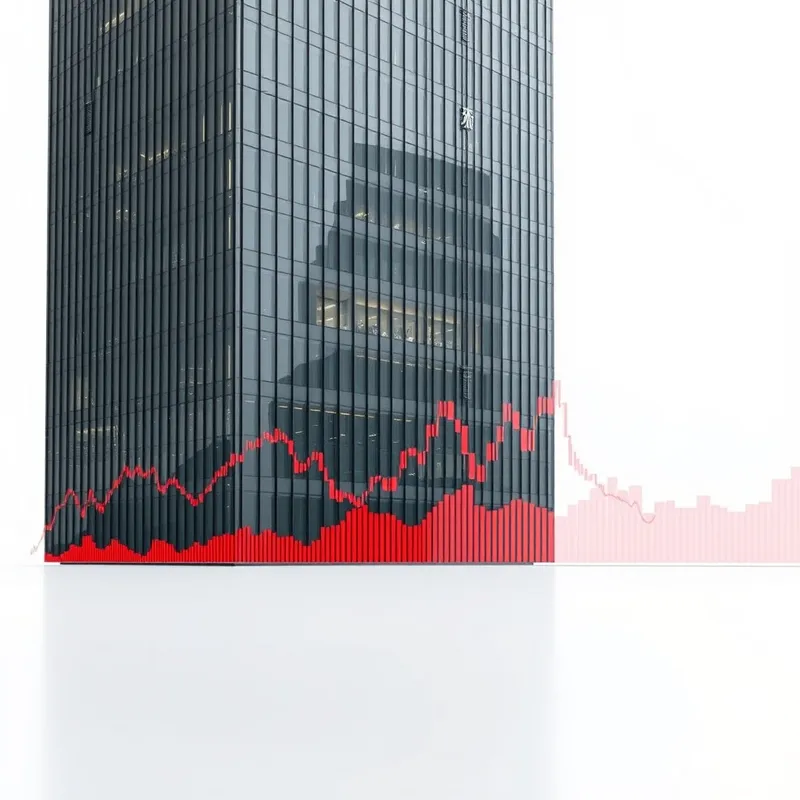
The global narrative surrounding tech-driven economic dominance is hitting a structural wall in East Asia. A severe divergence has opened up in South Korea, where sovereign currency valuation and blue-chip equities are moving in opposite directions. The benchmark KOSPI tumbled over 3% after a market holiday, erasing approximately 162.7 trillion won (roughly $108 billion) in equity market value. Concurrently, the tech-heavy KOSDAQ fell 4.29% to close at 853.98.
This market dislocation exposes a structural rift: foreign short-term capital is fleeing risk assets due to artificial intelligence valuation fatigue and geopolitical tensions, while corporate treasuries continue to flood local markets with dollar conversions, temporarily masking underlying asset weakness.
"Sovereign currency strength driven purely by legacy treasury unwinds is a paper tiger."

📉 The Mechanics of the Seoul Liquidity Vacuum
Foreign institutional capital initiated a massive liquidation campaign, dumping a net 458 billion won in benchmark equity shares in early morning trading alone. Semiconductor heavyweights bore the brunt of this exit: SK Hynix fell 3.81% to 1.617 million won, while Samsung Electronics dropped 3.63% to 252,500 won. This drawdown extended a multiday sliding trend, with Samsung and SK Hynix down 7.68% and 7.23% respectively over recent sessions.
What makes this drawdown analytically significant is the total breakdown between fundamental corporate profitability and market valuation. Samsung recently released preliminary third-quarter guidance projecting a record operating profit of 107.4 trillion won. Yet, market participants completely ignored these figures. Despite the correction, long-term performance remains structurally elevated, with SK Hynix up 138.85% year-to-date and Samsung holding a 96.5% gain.
The abrupt withdrawal of domestic corporate balance sheet support further compounds this volatility. Both semiconductor conglomerates are completing massive capital repurchases totaling approximately 55 trillion won in corporate share buybacks. As this buyback cushion dissipates, public order books are left exposed to unbuffered international capital outflows, escalating cross-asset volatility across Asian financial hubs.
🏛️ The De-Pegging of Corporate Performance and Foreign Exchange
Building on this domestic liquidity drawdown, foreign exchange markets displayed a stark counter-trend. The Korean won rallied as much as 0.8% to hit 1,333.30 per greenback—a two-year peak—before settling near a 0.5% gain. This trajectory reflects broader global macroeconomic factors, including softening crude oil prices and systemic weakness in the US dollar relative to the euro, British pound, and Japanese yen.
The mathematical driver of this fiat resilience is corporate dollar conversion. Tech exporters have systematically converted foreign trade revenues back into local fiat, reversing the currency's trajectory from one of Asia’s worst-performing assets in the early half of the year to a top performer with a 7.7% gain since January. However, this dynamic creates a severe illusion: corporate treasury conversions operate on a settlement lag, reflecting historical trade volume rather than future positioning.
🏛️ Anatomy of the 1998 Asian Liquidity Trap
When sovereign currencies strengthen alongside falling local equities, traditional market analysis often misdiagnoses the cause. A direct historical analogue occurred during the 1997–1998 Asian Financial Crisis. In the mid-to-late phases of that crisis, central bank interventions and emergency corporate dollar repatriations temporarily stabilized regional currencies. However, international equity investors continued to systematically exit equity positions due to underlying balance-sheet fragilities.
The structural lesson from 1998 is clear: export-driven currency strength cannot permanently insulate equity markets when global risk sentiment sours. In my view, current market pricing represents a delayed liquidity realization. Foreign funds are treating semiconductor equities as a liquid proxy to trim global AI overconcentration, completely decoupling equity valuations from short-term fiat exchange rates.
| Competing Force | The Irreconcilable Friction |
|---|---|
| Exporters (Dollar Sellers) vs Foreign Funds (Equity Sellers) | 🕴️ Converting foreign revenues into local fiat while global investors liquidate stock exposure. |
| Record Operational Profits vs Buyback Exhaustion | Peak earnings metrics fail to support stock prices once corporate repurchase programs end. |
| Macro Dollar Weakness vs Regional Risk Aversion | A softening greenback masks underlying structural exits from technology equities. |
🔮 Macro Volatility Spillovers and Strategic Re-Allocation
Connecting these historical foreign exchange patterns to the present environment, modern market microstructures are signaling an imminent volatility regime. The convergence of ending buybacks, elevated global interest rate expectations, and AI concentration risk leaves tech-heavy equity indices vulnerable to further distribution. As institutional market makers adjust to the loss of balance-sheet support, equity market depth will likely remain constrained across regional hubs.

For cross-asset allocators and digital asset markets, this market dislocation carries significant implications. When traditional technology equities experience simultaneous volatility and currency appreciation, capital historically flows into non-sovereign liquid hedges. If traditional tech infrastructure valuation multiples undergo a prolonged compression, institutional capital shifts toward alternative yield structures and decentralized liquidity venues to offset localized market drawdowns.
The divergence between sovereign currency strength and equity liquidation is rarely a stable equilibrium. As export-driven dollar conversions naturally decelerate in upcoming quarters, the foreign exchange rate will eventually re-align downward with equity market reality.
Institutional allocators must prepare for broader market spillovers. Expect high-beta technology sectors and alternative liquid assets to undergo heightened volatility as capital rotates away from concentrated legacy tech positions.
⚖️ Corporate Buyback Exhaustion: The structural market vulnerability that occurs when a corporation completes its planned share repurchase program, removing a primary source of consistent buy-side liquidity.
⚖️ Foreign Exchange Lag Effect: The temporary delay between recorded trade surpluses and the actual conversion of foreign currency earnings into domestic fiat, which can distort short-term currency valuations.
- If net foreign daily outflows exceed 500 billion won for three consecutive sessions → transition toward defensive capital preservation.
- If corporate dollar conversion volume drops below monthly averages → expect fiat exchange rate gains to abruptly reverse.
- If tech equity valuation multiples decouple from record earnings → monitor non-sovereign liquid assets for cross-market capital rotation.
— — coin24.news Editorial
This analysis is synthesized from aggregated market data and institutional research insights. It is provided for informational purposes only and should not be construed as financial advice. Cryptocurrency investments carry high risk; please conduct your own due diligence before making any investment decisions.
Related Intelligence

Institutional Onchain Infrastructure: The Liquidity Illusion

HTX Conference Marketing Masks Decay: Pure Marketing Theater

Solana Bot Extraction Threatens Swap: The Hidden Tax on Retail Liquidity

XRP Rebound Hides Spot Volume Crash: Spot Liquidity Mirage
Ledger Implant Breach Exposes Hidden: The 93M Hardware Vulnerability