What Happens to the AI Boom Now That Nvidia CEO Jensen Huang Is Gone?

The Silicon Solvency Trap: How Jensen Huang’s Exit Exposes AI’s Circular Debt Loop
Silicon Valley’s AI narrative just lost its primary structural architect at the worst possible moment.

When Nvidia stock sank more than 10% on Thursday following the unexpected resignation of CEO Jensen Huang, equity markets treated the announcement as an isolated executive leadership crisis. But the real vulnerability is not managerial—it is systemic concentration across the S&P 500, where the ten largest companies now represent between 36% and 40% of the benchmark index.
With Nvidia reporting earnings in five days without its founder, and the equity already slipping into a technical bear market down 20% from its peak on November 9, a broader repricing of artificial intelligence balance sheets threatens to spill into global retirement portfolios.
🔄 The Vendor-Financing Illusion: How Synthetic Revenue Built a Trillion-Dollar Bubble
Supplier financing occurs when a hardware vendor provides credit or equity investments directly to clients so they can purchase that vendor's equipment. In current technology infrastructure markets, major hyperscalers—specifically Amazon, Microsoft, Alphabet, Meta, and Oracle—are on track to expend roughly $660 billion on infrastructure this year, marking a 60% escalation over 2025 expenditure levels.

This capital loop relies on intricate balance-sheet interdependency rather than organic end-user demand. Broadcom’s credit arrangement allowing Anthropic to borrow up to $42 billion to rent computing capacity powered by Broadcom's own hardware demonstrates how supplier, creditor, and prospective equity holder have merged into a single entity, while Anthropic's filings reveal data-center commitments totaling $895.4 billion extending through 2045.
What this signals structurally is that Nvidia sat at the exact midpoint of these circular funding swaps. Huang personally engineered many of these synthetic balance sheet deals, raising uncomfortable questions about whether interim leadership—transitioned to CFO stewardship akin to Intel's 2018 corporate restructuring—can sustain such complex credit structures.
"When a hardware vendor finances its own buyer base, revenue growth becomes an illusion of capital velocity."
📉 Sovereign Yield Spikes and the Impending Debt Unwind
As these corporate balance sheets absorb expanding long-term lease obligations, macroeconomic conditions are rapidly tightening the broader cost of capital. Following hot October inflation metrics, the 10-year Treasury yield surged back to the 5% threshold, prompting interest rate swap markets to price in over a 90% probability of a Federal Reserve rate hike in December.

Elevated benchmark rates are exposing fragile capital structures across the specialized cloud sector. High-yield credit markets reflect severe stress, with compute-provider bond yields spiking past 16% for 2032 maturities, while leverage facilities cool across retail and institutional brokerages alike.
The broader equity index faced severe pressure following recent midterm election shifts, shedding roughly $3 trillion in market value during a single session while technology benchmarks dropped 6.36%. Sizing up this macro tension reveals an asset class operating with zero structural margin for error while valuation metrics approach multi-decade extremes.
| Asset / Entity | Peak Drawdown / Metric | Structural Risk Factor |
|---|---|---|
| CoreWeave | -55.96% from 2026 High | 2032 Bonds yielding >16% |
| Oracle | -47.89% from Peak | Heavy Hyperscaler Capex Commitments |
| Gold | -25.67% from Jan Record | Fully De-risked Sovereign Hedge |
| Bitcoin (BTC) | -16.76% YTD | Unencumbered Liquid Macro Sink |
📊 Capital Reallocation Dynamics: Why Digital Assets Offer Superior Asymmetry
Given the macro tension building in equity markets, technical charts reveal that technology valuation multiples are hitting historical boundaries. The cyclically adjusted price-to-earnings (CAPE) ratio for US equities currently hovers near 40—uncomfortably close to the historic 44.2 record set during the 2000 dot-com peak.
Here is what the market is missing: while artificial intelligence hardware vendors remain priced for flawless operational execution, liquid macro hedges have already experienced multi-month price resets. When parabolic equity cycles break down under the weight of debt service costs, institutional liquidity naturally migrates toward secondary pools that have already completed their leverage unwinds.
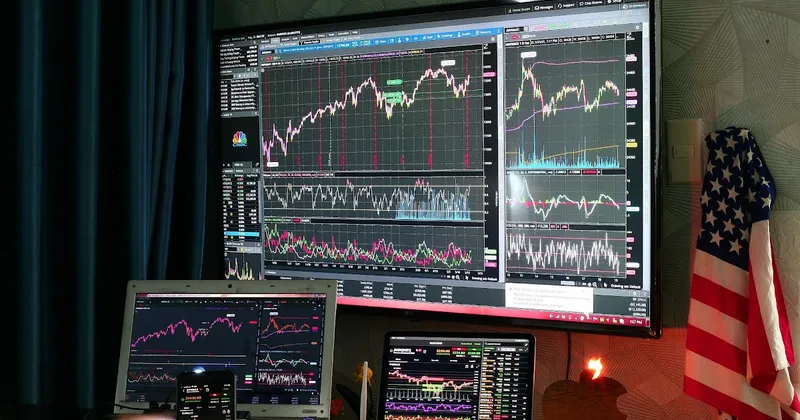
During prior technology bubbles, capital sought refuge in sovereign debt instruments and hard commodities. However, with sovereign yields elevated and central banks maintaining hawkish stances, liquid digital assets present a compelling structural alternative—offering high-beta upside detached from corporate vendor-financing defaults.
"Capital does not vanish during a tech unwind; it flees to assets that have already taken their pain."
🗓️ The Three-Week Crucible: Key Microstructure Drivers
The sequence of market events over the coming three weeks will dictate whether the broader equity market faces an orderly sector rotation or an aggressive liquidity crunch. Analysts are watching a tight cluster of corporate and regulatory milestones that will test system-wide liquidity.
Despite corporate
This analysis is synthesized from aggregated market data and institutional research insights. It is provided for informational purposes only and should not be construed as financial advice. Cryptocurrency investments carry high risk; please conduct your own due diligence before making any investment decisions.
Related Intelligence

Chainlink Pilots Reveal Token Trap: The Institutional Illusion

XRPL Shifts Quantum Burden To Nodes: Zero Fee Storage Risk

Gemini Firesale Marks Market Retreat: A $10M Regulatory Exit

Ethereum Sacrifices Speed for Shield: The Scalability Penalty

TRON Crime Alliance Exposes Fissures: The Compliance Mirage