Bitrue AI Masks Leverage With Presets: The 30-Day Backtest Facade
Bitrue AI Masks Leverage With Presets: The 30-Day Backtest Facade
Retail traders can now deploy automated futures leverage for 20 USDT—wrapped in a 30-day backtest that hides tail risk.

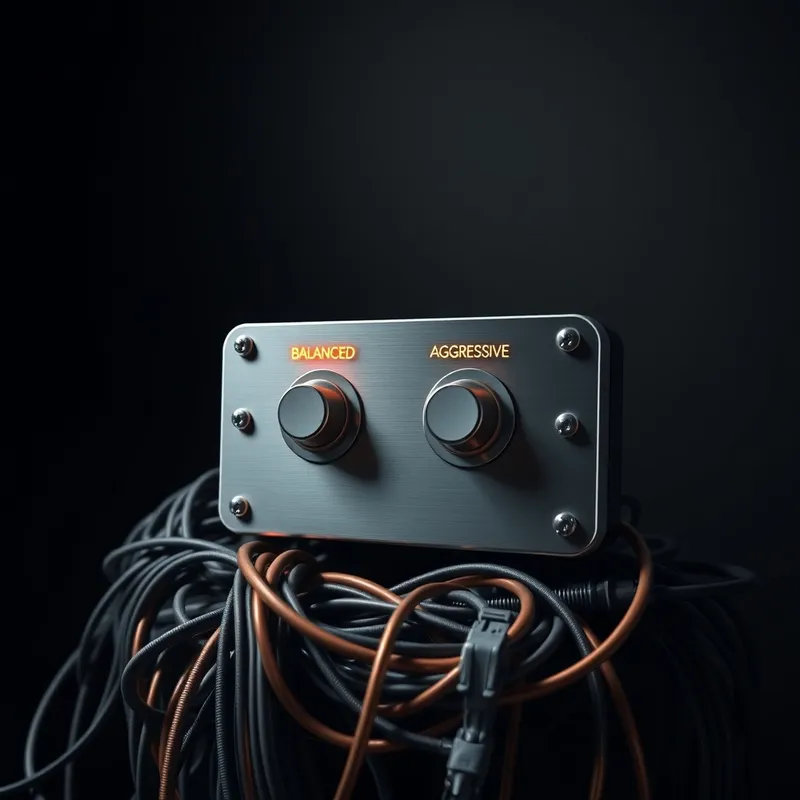
Exchange-native automated trading has crossed a critical threshold where complex derivatives exposure is packaged into consumer-friendly presets. By introducing "Balanced" and "Aggressive" strategy options to its Bitrue AI grid trading tool, Bitrue is lowering the friction between spot-style retail participation and leveraged futures execution.
🎭 The Behavioral Trap of Automated Risk Presets
Behavioral market dynamics show that retail participants consistently mistake interface simplicity for structural safety. When an exchange presents two side-by-side options for the same trading pair—such as BTC/USDT—the framing nudges users toward choosing between "moderate" and "high" rather than questioning whether a grid bot is appropriate for the current volatility regime.
Both presets draw on the exact same underlying market analysis and differ primarily in their leverage multipliers. Yet, presenting them as distinct strategic choices creates an illusion of diversification and control. In reality, a 30-day backtest in crypto is little more than a rear-view mirror in a hairpin turn, capturing recent range-bound chop while remaining blind to sudden liquidity vacuums.
This product evolution stems from internal survey data of 8,280 users, where half of non-bot users expressed willingness to try automated tools if risk controls were clearer. The pattern suggests exchanges are not necessarily solving for alpha generation; they are solving for user onboarding friction by translating intimidating derivatives parameters into digestible retail narratives.

"Simplicity in a trading interface rarely eliminates complexity; it simply hides where the risk lives."
⚙️ Under the Hood: Grid Mechanics and 15-Minute Recalibration
To understand the operational reality of these automated presets, it helps to look at how grid bots actually interact with order books. A grid bot places a series of staggered buy and sell orders within a predetermined price corridor, profiting from sideways oscillation while accumulating directional exposure if the price breaks out.
Under the hood, Bitrue AI scans market conditions every 15 minutes to update its suggested grid range, order density, and directional bias. Once a user commits capital—starting at a low threshold—the system executes spot or futures orders internally without requiring external API keys. Users retain manual overrides for take-profit, stop-loss, and maximum drawdown limits before activation.
Here is where it gets structural: there is an inherent tension between exchange volume incentives and user capital preservation. Automated grid bots generate continuous, high-frequency maker and taker fees for the host platform, especially when amplified by futures leverage. While the exchange provides written explanations of market conditions to satisfy user demand for transparency, the core business model benefits directly from the velocity of capital turnover.
In my view, relying on a short-term rolling backtest to calibrate leveraged grid parameters introduces severe convexity risk. When a trending breakout occurs, a "Balanced" bot with lower leverage still bleeds steadily against the trend, while an "Aggressive" bot accelerates toward liquidation before a 15-minute rescan can meaningfully adapt.

🌊 Market Microstructure: Volume Velocity vs. Retail Drawdown
If this behavioral framing successfully converts hesitant spot holders into active futures participants, the immediate impact on market microstructure will be a measurable uptick in automated order-book density. Exchanges with massive retail footprints—such as Bitrue, which reports over 40 million users globally—can manufacture substantial internal liquidity by funneling small-ticket accounts into continuous grid execution.
However, this localized liquidity comes with a structural fragility. When thousands of retail accounts run identical, exchange-generated parameters on major pairs, their stop-loss and liquidation levels cluster around predictable price bands. During sharp macro-driven sell-offs, these automated clusters act as fuel for cascading liquidations rather than stabilizing market depth.
Furthermore, the strict geographic exclusion of major regulated jurisdictions—including the US, UK, EEA, Canada, and China—highlights the regulatory reality surrounding automated leverage. Regulators increasingly view gamified, one-click derivatives presets as unsuitable for retail investors, pushing this entire class of product innovation into offshore liquidity pools.
"When thousands of bots share the same brain, their exits become a single crowded door."
🔭 Navigating the Next Wave of Exchange-Native Automation
Given these microstructural tensions, the proliferation of AI-branded trading presets is poised to become standard infrastructure across offshore crypto exchanges. As spot trading margins compress, platforms will aggressively compete to monetize their user bases through automated derivatives turnover, using natural-language explanations to bridge the trust gap.

For disciplined market participants, the opportunity lies not in blindly adopting exchange-suggested presets, but in recognizing how these bots alter short-term support and resistance dynamics. Understanding where retail-driven grid liquidity sits allows sharper traders to anticipate breakout acceleration when those ranges inevitably fail.
The current market dynamics suggest that retail appetite for automated tools is genuine, driven by a desire to offload emotional decision-making. Yet outsourcing execution to an exchange-hosted bot often trades emotional error for systematic regime blindness.
Over the medium term, expect volatility spikes to become sharper around key psychological levels as clustered grid bots trigger synchronized stop-losses. Investors who treat "Balanced" presets as low-risk yield vehicles will likely learn the hard way that leverage, regardless of its label, always collects its due during trend transitions.
📉 Maximum Drawdown: The largest peak-to-trough percentage decline in a portfolio or strategy's value over a specific period, measuring downside risk.
📊 Grid Trading: An automated strategy that places staggered buy and sell orders at preset intervals around a base price to profit from sideways market volatility.
- If BTC/USDT breaks out of its 30-day realized volatility band → automated grid bots transition from fee generation to rapid directional drawdown.
- If offshore exchange open interest spikes alongside flat spot volume → retail-driven leveraged bot activity is likely crowding the order book.
- If regulatory enforcement targets gamified derivatives interfaces → offshore platforms face abrupt user-acquisition bottlenecks in compliant jurisdictions.
— coin24.news Editorial
This analysis is synthesized from aggregated market data and institutional research insights. It is provided for informational purposes only and should not be construed as financial advice. Cryptocurrency investments carry high risk; please conduct your own due diligence before making any investment decisions.
Related Intelligence

Solana Rebound Meets Heavy Resistance: The 80 Dollar Overhang

Nvidia Earnings Beat Masks Stock Drag: The Post-Huang Overhang

BlackRock ETF Rebound Masks Fragility: Institutional Trap at 64k

AI Trading Agents Surge 5x In Crypto: Autonomous Trading Pivot

Nvidia Drops 4 Percent As Tech Bleeds: A Crypto Decoupling Test